
Bimolecular Fluorescence Complementation (BiFC)
Service Features
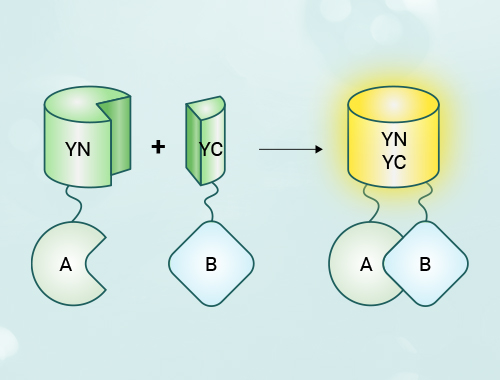
Bimolecular fluorescence complementation (BiFC) splits a fluorescent protein into two non-fluorescent fragments fused to target proteins. When the proteins interact, fluorescence is restored, allowing direct observation of interactions and subcellular localization in living cells.
Service Overview
Bimolecular fluorescence complementation (BiFC) studies protein-protein interactions based on fragment complementation. A fluorescent protein is split into two non-fluorescent complementary fragments fused to target proteins and co-expressed in cells. When the targets interact, the fragments come together and reassemble into a functional fluorescent protein, producing a signal observable under a microscope and providing direct evidence of interaction.
Service Advantages
- Live-cell detection: directly observes interactions under physiological conditions with spatiotemporal information.
- High specificity: fluorescence appears only when targets interact, reducing false positives.
- Detects weak or transient interactions: sensitive to low-affinity, short-lived interactions.
- Reveals subcellular localization of interactions.
- Works in many systems: mammalian cells, plant cells, yeast, etc.
Service Workflow
Order and sample intake
-
1
Fusion protein construction
-
2
Cell transfection
-
3
Fluorescence imaging
-
4
Results delivery
The BiFC service follows a 5-step workflow to ensure accurate, reliable live-cell interaction results.
Customer Provides
1. Protein sequence information.
2. Sample requirements:
Customer-provided vector or template: a vector MCS sequencing report or template sequencing result is required; otherwise an additional sequencing fee applies and Proabbio performs sequencing.
Customer-provided bacterial culture: volume at least 0.5 mL; glycerol stocks older than one year must be revived before submission.
Customer-provided plasmid: at least 5 ug.
Bacterial cultures and liquid plasmids must ship on ice packs.
Service Description
| Item | Description |
|---|---|
| Deliverables | Remaining plasmid. Microscopy images: 1 field each for negative and positive controls, 5 fields each for 2 single-molecule negative controls and 1 experimental group, with YFP, brightfield, and merge images per field. Final report containing all raw data. |
| Notes | Specific scope, sample requirements, and acceptance criteria are subject to the project plan confirmed by both parties. |
Ready to Start Your Project?
Our technical team can help with experimental design, sample evaluation and study execution. Contact us for a consultation or quote.
Talk to a Scientist